Navigating the Base Rate Ripple Effect: Fixing vs. Floating Business Finance
Every business owner with a loan, or plans to take one out, is asking the same question right now: are interest rates finally heading down, or is the cost of borrowing about to climb again? The honest answer is that nobody knows for certain, but understanding what’s driving the uncertainty can help you make a smarter decision either way.
This guide breaks down where UK interest rates currently stand, what’s influencing the outlook, and how SMEs can decide between fixed and variable business finance in a market that’s anything but predictable.
Why This Question Keeps Coming Up
For much of 2024 and 2025, the direction of travel felt fairly clear: rates were coming down, gradually and predictably. That made planning easier, whether you were fixing a loan, budgeting for repayments, or simply deciding when to apply. 2026 has broken that pattern, and business owners who assumed the downward trend would simply continue are now having to rethink their approach.
Where UK Interest Rates Stand Right Now
The Bank of England’s Current Position
The Bank of England has held its base rate steady through multiple consecutive meetings in 2026, following a series of cuts during 2024 and 2025 that brought rates down from a recent high. Rather than continuing that downward trend into 2026, the Monetary Policy Committee has taken a more cautious “wait and see” approach.
Why the Outlook Has Shifted
Earlier forecasts for 2026 pointed toward further rate cuts, driven by cooling inflation and a softening jobs market. That outlook has become murkier, largely due to geopolitical tension affecting energy prices, which has reintroduced inflation risk into the equation.
A Genuinely Split Forecast
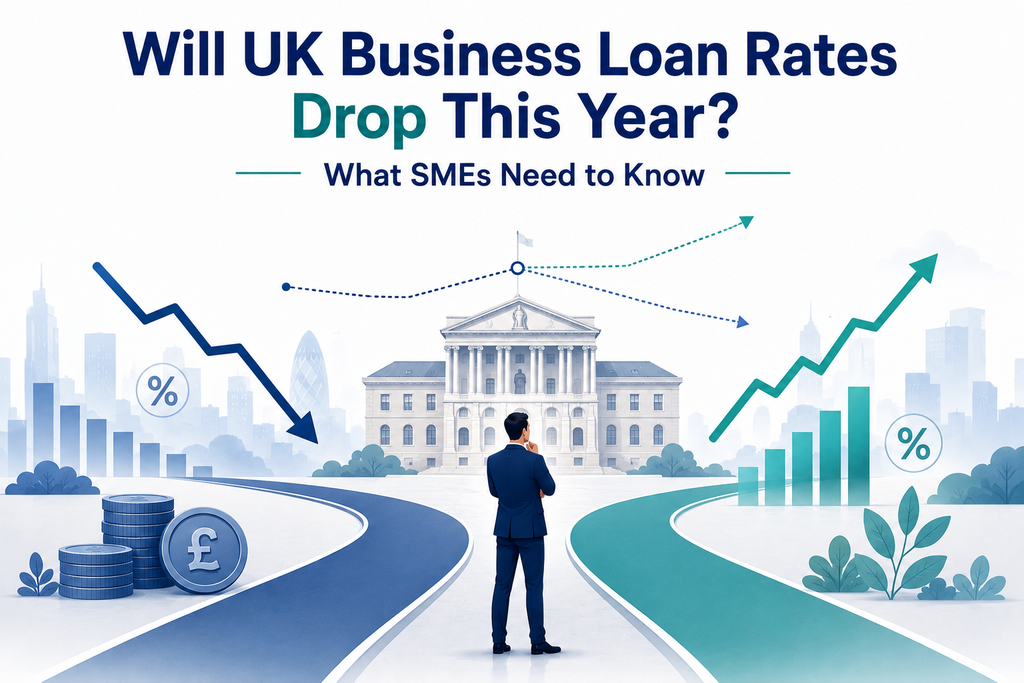
Economists remain divided. Some still expect gradual rate cuts later in the year or into 2027, as underlying inflation pressures continue to ease. Others believe the Bank may need to hold rates steady for longer, or even consider an increase, if energy-driven inflation proves more persistent than hoped.
What This Means in Practice
For SMEs, this uncertainty is the real headline. Rather than a confident prediction in either direction, the honest position is that rates could move either way over the coming months, which makes your own finance strategy more important than trying to predict the Bank’s next move.
Businesses that build flexibility into their planning, rather than betting heavily on one outcome, tend to weather this kind of uncertainty far more comfortably than those who delay every decision waiting for clarity that may not arrive for some time.
Why the Base Rate Affects Your Business Loan
The Ripple Effect Explained
The Bank of England’s base rate acts as a benchmark that influences borrowing costs across the entire economy, including business loans, not just mortgages. When the base rate moves, lenders typically adjust their own pricing to reflect the change, though the timing and scale of that adjustment varies by lender and product.
Not All Business Finance Reacts the Same Way
How directly the base rate affects your repayments depends heavily on whether your finance is fixed or variable, which brings us to the central decision every SME borrower faces right now.
Fixed vs. Variable Business Finance: The Core Difference
Fixed-Rate Business Loans
A fixed-rate loan locks in your interest rate for the full term, or an agreed period, regardless of what happens to the base rate afterward. Your repayments stay the same, giving you certainty over your monthly costs.
Advantages of Fixing
- Predictable repayments make budgeting easier
- Protection if rates rise unexpectedly
- Peace of mind during periods of economic uncertainty
Trade-Offs of Fixing
- You won’t benefit if rates fall after you’ve locked in
- Fixed rates are sometimes priced slightly higher than variable options at the point of borrowing, to reflect the lender’s own risk in offering rate certainty
Variable (Floating) Rate Business Finance
A variable, or floating, rate moves in line with an underlying benchmark, often tied directly or indirectly to the base rate. Your repayments can rise or fall over the term of the loan.
Advantages of Floating
- You benefit automatically if rates fall
- Often more flexible, with fewer early repayment penalties
- Can suit businesses comfortable managing some repayment variability
Trade-Offs of Floating
- Repayments can increase if rates rise
- Less predictable for cash flow planning
- Requires closer monitoring of rate movements
How to Decide Between Fixing and Floating Right Now
Step 1: Assess Your Risk Tolerance
If your business relies on predictable monthly costs to manage cash flow confidently, a fixed rate removes one major variable from your planning, even if the headline rate is marginally higher.
Step 2: Consider Your Loan Term
For shorter-term finance, rate movements have less time to significantly affect your total repayment. For longer-term borrowing, the direction of rates over several years becomes a much bigger factor in your overall cost.
Step 3: Factor In the Genuine Uncertainty
Given how split current forecasts are, betting heavily on rates falling soon carries real risk. A balanced approach, or a product that allows some flexibility to review your position later, may suit businesses who aren’t confident predicting which way rates will move.
Step 4: Compare Products Across Multiple Lenders
Fixed and variable pricing varies significantly between lenders, and some offer hybrid structures that combine elements of both. Comparing your options properly, rather than accepting the first offer, ensures you’re not paying more than necessary for the certainty, or flexibility, you want.
Ask About Early Repayment and Rate Review Options
Before committing to either structure, ask whether the loan allows early repayment without heavy penalties, and whether a fixed rate can be reviewed or renegotiated if market conditions shift significantly during the term.
What This Means for Different Types of Business Finance
Working Capital Loans
Short-term working capital loans are less exposed to long-term rate uncertainty, given their shorter repayment periods, making them a relatively lower-risk option to arrange even amid an unclear rate outlook.
Secured Business Loans
Larger, longer-term secured business loans are more exposed to the direction of rates over time, making the fixed vs. variable decision especially important for this type of borrowing.
Unsecured Business Loans
Unsecured business loans often come with fixed terms already built in, offering a straightforward way to lock in certainty without needing to navigate a variable structure.
Asset Finance
Asset finance agreements are frequently fixed for the term, aligning naturally with the predictable use of the equipment being financed, which can simplify the fixed vs. floating decision for this product type.
Merchant Cash Advance
A merchant cash advance operates differently again, with repayments tied to card sales rather than a base-rate-linked interest structure, making it largely insulated from this particular decision altogether.
Why Timing Your Application Matters
Applying Now vs. Waiting
Some business owners consider delaying a loan application in the hope that rates fall further. Given how uncertain current forecasts genuinely are, this strategy carries real risk, if rates hold steady or rise instead, waiting may end up costing more, not less.
Locking In Certainty While It’s Available
If your business needs funding regardless of the rate environment, and a competitive fixed rate is currently available, locking it in can remove the guesswork entirely, rather than gambling on a forecast that even professional economists can’t agree on.
The Cost of Indecision
It’s worth remembering that delaying a funding decision has its own cost, missed growth opportunities, stretched cash flow, or a stalled investment plan. Weigh the potential saving from a possible future rate cut against the real, immediate cost of putting your business plans on hold while you wait to see what happens.
Why Choose 247 Business Finance to Navigate This Market
Rate uncertainty makes it more important than ever to compare your options properly, rather than guessing which way the market will move. We help UK SMEs access competitive fixed and variable finance across a wide panel of lenders.
Our Key Advantages
90% Approval Rates
We compare a wide panel of lenders, helping match your business to the right rate structure for your situation. See our 90% approval rate plans.
Faster Funding Options
Whether you’re locking in a rate now or need funding quickly, we help you move fast. Explore our faster funding options.
Flexible Repayments
We help you find a repayment structure, fixed or variable, that suits your business’s risk appetite and cash flow. Learn more about our flexible repayment options.
Less Paperwork
We keep the comparison and application process simple and efficient. Find out more about our low paperwork process.
Low Interest Rates
By comparing the market on your behalf, we help you access competitive rates regardless of which direction the base rate moves next. Check our low interest rate options.
Other Finance Options Worth Exploring
- Secured Business Loan — larger amounts backed by an asset
- Unsecured Business Loan — funding without pledging collateral
- Working Capital Loan — for day-to-day cash flow needs
- Asset Finance — fund equipment or machinery
- Merchant Cash Advance — funding based on card sales
- Start Up Loan — for newer businesses
- Recovery Loan Scheme — government-backed support for eligible businesses
- Business Card Payment Solutions — improve how you take payments
Frequently Asked Questions
Will UK Business Loan Rates Definitely Fall This Year?
There’s no certainty either way. While some economists still expect gradual cuts later in the year, others believe rates may hold steady or even rise if inflation pressures persist, largely linked to energy price volatility.
Should I Wait to Apply for a Business Loan Until Rates Drop?
Waiting carries risk given how divided current forecasts are. If your business needs funding now, and a competitive rate is available, applying today may be more prudent than gambling on an uncertain future rate cut.
Is a Fixed or Variable Rate Better Right Now?
It depends on your risk tolerance and loan term. A fixed rate offers certainty if you value predictable repayments, while a variable rate could benefit you if rates fall, but exposes you to higher costs if they rise instead.
How Often Does the Bank of England Review the Base Rate?
The Bank of England’s Monetary Policy Committee meets roughly every six weeks throughout the year to review and decide on the base rate.
Do All Business Loans Move in Line With the Base Rate?
No. Fixed-rate loans stay the same regardless of base rate movements, while variable-rate products are more directly affected. Some finance types, like merchant cash advances, aren’t tied to the base rate at all.
Can I Switch From a Variable to a Fixed Rate Later?
This depends on the lender and loan agreement. Some products allow you to switch or refinance, though this may involve fees or a new application. It’s worth clarifying this option before committing to either structure.
What’s Driving the Current Rate Uncertainty?
Ongoing geopolitical tension affecting global energy prices has reintroduced inflation risk into the outlook, complicating what had previously looked like a clearer path toward further rate cuts. This has left economists genuinely divided on the likely direction for the rest of the year.
Final Thoughts
Nobody, including the Bank of England’s own policymakers, can say with certainty whether UK interest rates will fall, hold, or rise over the rest of the year. What’s clear is that the outlook has become genuinely more uncertain, driven largely by geopolitical pressure on energy prices feeding into inflation forecasts.
For SMEs, this makes the fixed vs. variable decision more important than usual. Rather than trying to time the market, focus on what your business can comfortably manage, and compare your options properly to find the right structure for your specific circumstances.
Get in touch with 247 Business Finance today.
📞 Call us: (0800) 061 4919 📧 Email: info@247businessfinance.com 🌐 Get your free quote now
We compare the market so you don’t have to, helping UK SMEs navigate uncertain rates with confidence.