Late Payment Reforms: How UK Law Changes Impact SME Cash Flow & Lending
Late payments have long been a thorn in the side of small and medium-sized enterprises (SMEs) across the United Kingdom. In fact, according to the Federation of Small Businesses (FSB), late payments cost UK SMEs over £2.5 billion every year. To tackle this issue, the UK Government has introduced late payment reforms in 2025, aiming to strengthen cash flow protection and boost SME lending.
At 24/7 Business Finance, we know how vital timely payments are for business survival. Whether you’re navigating late payment challenges, exploring supply chain finance UK, or seeking trade finance for SMEs UK, our tailored funding solutions help protect your business cash flow.
1. The Problem with Late Payments in the UK
Late payments aren’t just an inconvenience—they can be devastating for SMEs.
- Over 60% of SMEs report being paid late by larger corporations.
- Average payment delays exceed 22 days beyond agreed terms.
- This leads to cash flow gaps, rising debt, and even insolvency for smaller businesses.
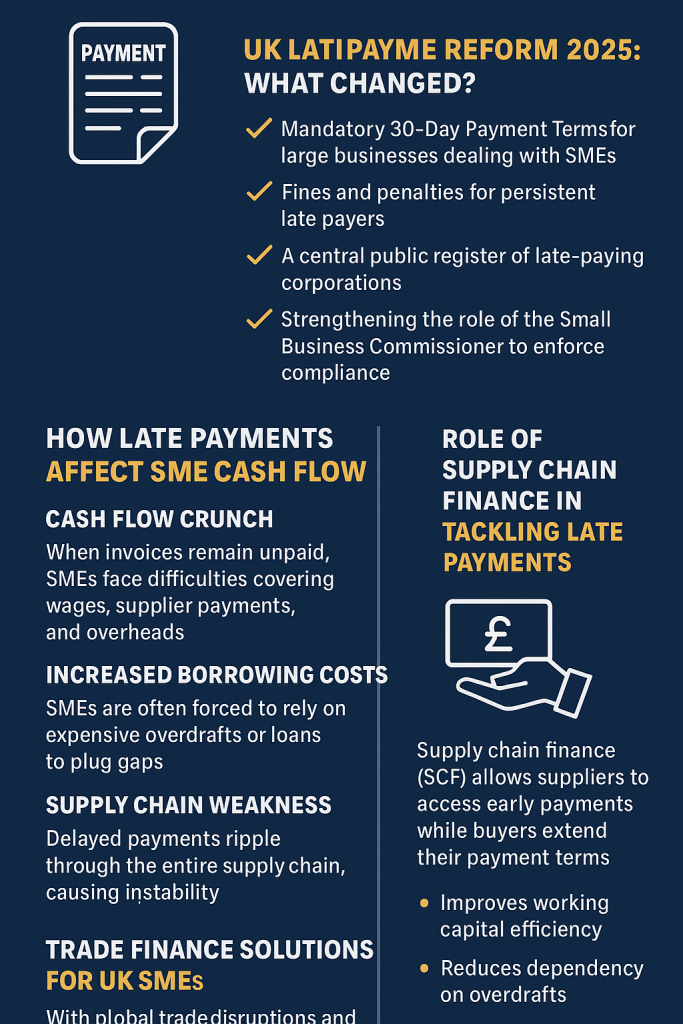
2. UK Late Payment Reform 2025: What Changed?
The UK Government announced new measures designed to strengthen protections for SMEs:
- Mandatory 30-Day Payment Terms for large businesses dealing with SMEs.
- Fines and penalties for persistent late payers.
- A central public register of late-paying corporations.
- Strengthening the role of the Small Business Commissioner to enforce compliance.
These reforms aim to level the playing field and ensure SMEs get paid faster.
3. How Late Payments Affect SME Cash Flow
3.1 Cash Flow Crunch
When invoices remain unpaid, SMEs face difficulties covering wages, supplier payments, and overheads.
3.2 Increased Borrowing Costs
SMEs are often forced to rely on expensive overdrafts or loans to plug gaps.
3.3 Supply Chain Weakness
Delayed payments ripple through the entire supply chain, causing instability.
This is why more businesses are turning to supply chain finance UK and trade finance SMEs UK to smooth operations.
4. Role of Supply Chain Finance in Tackling Late Payments
Supply chain finance (SCF) allows suppliers to access early payments while buyers extend their payment terms. This helps SMEs unlock liquidity without waiting months for payments.
- Improves working capital efficiency.
- Reduces dependency on overdrafts.
- Strengthens supplier-buyer relationships.
Read more about working capital loan solutions we provide for SMEs.
5. Trade Finance Solutions for UK SMEs
With global trade disruptions and Brexit complexities, trade finance for SMEs UK is vital. It helps SMEs:
- Access upfront funding for imports/exports.
- Mitigate risks linked to international payments.
- Bridge gaps created by late-paying buyers.
At 24/7 Business Finance, we offer Recovery Loan Scheme options and tailored trade finance packages to help SMEs thrive despite late payment risks.
6. Benefits of the New Late Payment Law for SMEs
- Faster Payments: Guaranteed within 30 days.
- Reduced Reliance on Expensive Lending: Less need for emergency borrowing.
- Greater Transparency: Buyers with poor payment practices are exposed.
- Boost in SME Growth: Healthy cash flow supports expansion.
7. Challenges Still Ahead
While reforms are promising, SMEs still face challenges:
- Enforcement of penalties may take time.
- SMEs may hesitate to report powerful buyers.
- International trade remains exposed to cross-border payment delays.
This makes flexible finance solutions from providers like 24/7 Business Finance even more important.
8. How 24/7 Business Finance Supports SMEs
We specialise in quick, tailored SME funding in the UK, helping businesses tackle late payment challenges through:
- Unsecured Business Loans – fast access to cash with no collateral.
- Working Capital Loans – designed to ease cash flow gaps.
- Start-Up Loans – supporting new businesses during high-risk early stages.
- Supply Chain & Trade Finance – customised funding for SMEs affected by trade disruptions.
📞 Call us today on 0800 061 4919 or visit our Contact Us page to discuss your finance needs.
9. Case Study: SME Cash Flow Success
A London-based design agency faced 45-day late payments from large corporate clients, creating payroll stress. By using supply chain finance UK through 24/7 Business Finance, the agency gained immediate access to 90% of invoice value—solving cash flow issues without adding long-term debt.
10. External Perspective
The UK Government’s consultation on late payments confirms the reforms aim to save SMEs from insolvency and strengthen growth.
(UK Gov consultation)
Trade finance experts also note that SMEs adopting SCF and digital financing tools are more resilient against late payments.
(Trade Finance Global)
Conclusion
Late payments have been one of the biggest threats to SME cash flow in the UK, but with the 2025 reforms, SMEs now have stronger protection. However, enforcement challenges mean SMEs must still be proactive in managing liquidity.
At 24/7 Business Finance, we provide tailored business loans, supply chain finance, and trade finance solutions to help SMEs stay resilient.
📞 For fast SME finance support, call 0800 061 4919 or get in touch here.
FAQs
1. What is the UK’s new late payment law in 2025?
Large companies must pay SMEs within 30 days, or face fines and public listing.
2. How do late payments affect SMEs?
They restrict cash flow, increase borrowing costs, and damage supplier relationships.
3. Can supply chain finance help SMEs deal with late payments?
Yes, it allows suppliers to access early payments, protecting cash flow.
4. What is trade finance for SMEs in the UK?
It provides upfront funding for imports and exports, reducing payment delay risks.
5. How can I access SME finance quickly in the UK?
Contact 24/7 Business Finance at 0800 061 4919 for fast approval on tailored loans.