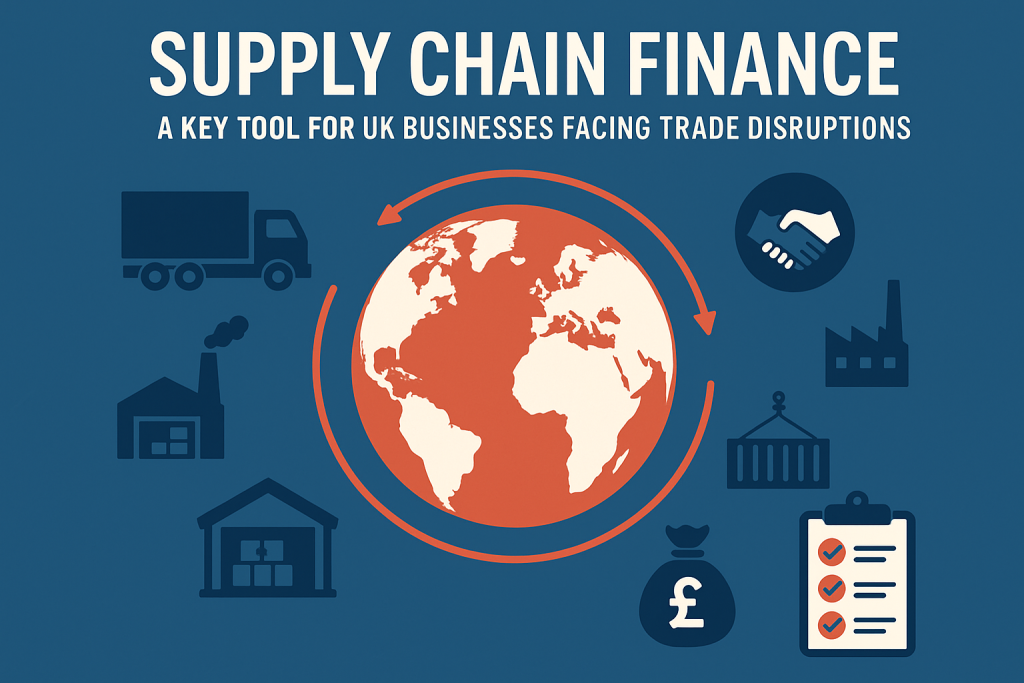
Supply Chain Finance: A Key Tool for UK Businesses Facing Trade Disruptions in 2025
In a global economy marked by Brexit-related changes, geopolitical friction, and supply chain disruptions, UK businesses—especially SMEs—are facing growing challenges. From late payments to stretched cash flow, many SMEs struggle to maintain liquidity while managing supplier relationships. That’s where supply chain finance UK steps in.
By leveraging trade finance for SMEs UK, businesses can protect working capital, sustain resilience, and mitigate risk—all without tying down liquidity. At 24/7 Business Finance, we support UK SMEs with tailored supply chain finance and trade finance solutions to weather uncertainty and grow sustainably.
1. What Is Supply Chain Finance?
Supply chain finance (SCF), also known as reverse factoring or supplier finance, is a working capital solution that allows suppliers to get paid early while granting buyers extended payment terms. It’s cash-flow positive for both parties, anchored on the buyer’s creditworthiness rather than the supplier’s financial health.
- Suppliers receive up to 100% of invoice value almost immediately.
- Buyers get to defer payment without impacting working capital.
Swoop UK+1
2. How Supply Chain Finance Works
- The supplier issues an invoice to the buyer.
- The buyer approves the invoice and confirms it with the finance provider.
- The supplier receives payment early (minus a small fee).
- On invoice due date, the buyer pays the lender.
This structure ensures faster payment to suppliers and better cash flow management for buyers.
Swoop UK+1
3. Why UK SMEs Need SCF in 2025
3.1 Trade Disruptions & Payment Delays
Ocean freight bottlenecks, Brexit customs delays, and currency volatility have intensified supplier payment delays. SCF helps stabilize cash flow in uncertain trade conditions.
3.2 Supply Chain Resilience & Working Capital Efficiency
SCF enhances supply chain resilience by reducing financial strain. It’s rapidly being embraced by export-oriented SMEs.
Trade Finance Global+1
3.3 Growing Demand for Trade Finance in SMEs
The UK trade finance market is forecast to grow at 4% CAGR through 2033, reaching $4.25bn—highlighting rising SME dependence on flexible finance.
Grand View Research
4. Benefits of Supply Chain Finance for UK SMEs
- Improved Cash Flow: Receive early payment without waiting for buyer settlement.
- Lower Financing Costs: Fees based on buyer’s credit rating—typically cheaper than factoring.
- Stronger Buyer Relationships: Maintain reliable partnerships with suppliers and buyers.
- No Collateral Required: Financing depends on buyer strength, not supplier assets.
- ESG Incentives: Sustainable SCF gives preferential terms to suppliers meeting ESG targets.
Swoop UK+2Global Finance Magazine+2
5. Trade Finance vs. Supply Chain Finance vs. Factoring
| Feature | Trade Finance | Supply Chain Finance | Factoring |
|---|---|---|---|
| Collateral Needed | Often (letters of credit) | ❌ No | Partial (invoice as asset) |
| Payment Speed for Supplier | Often delayed | Immediate | Within days but partial |
| Cost | Moderate to high | Lower (buyer-scored) | Higher (supplier-rated) |
| Buyer Relationship | Separate | Collaborative | Not required |
| Best For | Export/import trade | Domestic and international | Supplier liquidity focus |
| Wikipedia+1 |
6. Trends Shaping Supply Chain and Trade Finance in 2025
Digital Platforms & AI Automation
Platforms using blockchain and AI enable real-time invoice tracks, risk scoring, and auto-approval workflows.
Pacific Corp+2LinkedIn+2
Green and Sustainability-Linked SCF
Lenders are offering preferential rates when suppliers meet ESG criteria—boosting sustainability across supply chains.
Trade for Prosperity+1
Regulatory Reforms
UK regulators and the ICC are calling for improvements to ease SME access to trade finance (~£22bn trade finance gap) via digital trade docs and streamlined KYC.
Financial Times
7. Role of 24/7 Business Finance in SCF & Trade Finance
At 24/7 Business Finance, we help UK SMEs access trade and supply chain financing through:
- Reverse factoring-based SCF solutions tailored to SME-sized businesses
- Access to import/export trade finance tools for cross-border operations
- Unsecured trade credit engines using buyer credit to fund suppliers
Learn more about our tailored services for suppliers and buyers at:
- Our Services
- Unsecured Business Loan
- Working Capital Loan
- Trade or Export Finance support via Recovery Loan Scheme
8. Case Study: SME Trade Finance Success
Consider a Midlands-based metal components supplier to a large auto-manufacturer. Long payment terms of 60 days caused severe cash flow stress, delaying raw material payments. Through SCF arranged by 24/7 Business Finance, the supplier received invoice payment within days, while the buyer paid after 90 days—shoring up supplier cash flow without harming buyer liquidity.
9. Risks and What UK SMEs Should Consider
- Buyer credit risk: If a buyer defaults, SCF could be disrupted.
- Supplier fees: Generally lower than factoring, but still present.
- Platform onboarding: Suppliers must be onboarded and approved by funders.
Always work with regulated providers like 24/7 Business Finance to ensure compliance and transparent terms.
Acuity Knowledge Partners+1
10. How to Apply for Supply Chain Finance with 24/7 Business Finance
- Visit our Contact Us page.
- Reach out via phone at 0800 061 4919.
- Share your buyer/supplier invoice terms and credit situation.
- We analyze suitability and offer a SCF solution based on buyer credit.
- Finance approved—supplier receives early payment, buyer extends terms.
11. Future Outlook: Growth of Trade Finance & SCF in the UK
- SME trade finance uptake is rising, supported by investment in fintech platforms (~£2.3bn VC in 2025).
Pacific Corp+1 - IFC and global institutions estimate global demand for SCF at $2.5 trillion, with SMEs needing more support.
IFC - The UK’s push for digital trade infrastructure and ESG-linked lending will boost SCF adoption among both SMEs and larger corporates.
Conclusion
For UK businesses battling trade disruptions and cash flow challenges, supply chain finance UK offers a strategic lifeline. It enables smoother operations, stronger supplier relationships, and better trade resilience—all without needing collateral.
At 24/7 Business Finance, we specialise in trade and supply chain financing tailored to SME needs. Whether you’re a supplier or buyer, our flexible and efficient solutions can safeguard liquidity and fuel growth.
📞 Call us at 0800 061 4919 or contact us online to explore SCF options for your business today.
FAQs
1. What is supply chain finance and how does it work?
It allows suppliers to receive early payment based on buyer-approved invoices. Buyers benefit by extending payment terms.
Swoop UK
2. Who should use supply chain finance in the UK?
Both buyers (to protect working capital) and SME suppliers (to speed up cash flow). Ideal for trade-reliant businesses.
3. How does SCF differ from invoice financing?
SCF relies on buyer credit rather than supplier financial history, and often offers better costs and payment speed.
Swoop UK+1
4. Can I access SCF through 24/7 Business Finance?
Yes, we provide bespoke supply chain-finance solutions and trade financing packages. Contact us at 0800 061 4919.
5. Is supply chain finance regulated?
Yes, reputable providers, including 24/7 Business Finance, operate under FCA guidelines and ensure compliance in onboarding and funding.