SME Lending Surge 2025: What the £4.6 Billion Q1 Lending Means for Small UK Businesses
SME lending in the United Kingdom has reached new heights. According to UK Finance, lending to small and medium-sized enterprises (SMEs) by high street banks hit £4.6 billion in Q1 2025, representing a 14% year-on-year increase. For small businesses navigating cash flow challenges, inflation, and late payments, this surge in funding opportunities is both a relief and a signal of changing times.
At 24/7 Business Finance, we see these numbers as more than statistics. They represent real opportunities for entrepreneurs, start-ups, and SMEs to grow, innovate, and thrive. Whether you need an unsecured business loan, a working capital loan, or support through the Recovery Loan Scheme, we make sure you get the required financing in the shortest possible time.
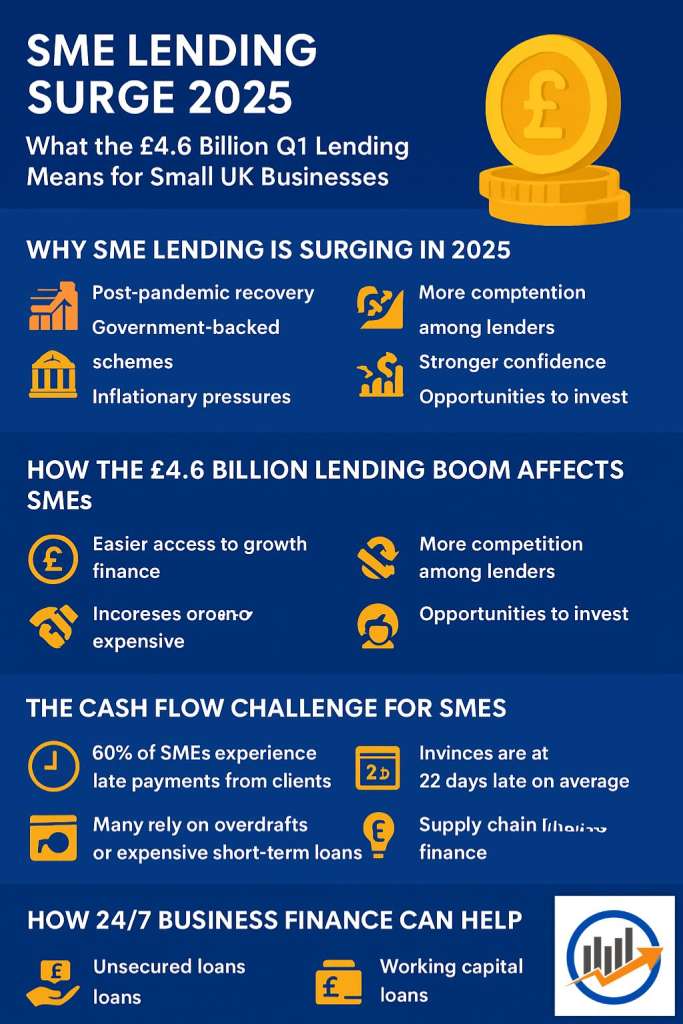
1. Why SME Lending Is Surging in 2025
Several factors are driving the boom in SME lending:
- Post-pandemic recovery: Businesses are investing again after years of uncertainty.
- Government-backed schemes: The Recovery Loan Scheme (RLS) continues to boost SME funding confidence.
- Inflationary pressures: SMEs need working capital to cover higher costs of raw materials, wages, and energy.
- Supply chain disruptions: Many companies are using supply chain finance in the UK to stabilise operations.
2. How the £4.6 Billion Lending Boom Affects SMEs
This lending surge has important implications for small businesses:
- Easier access to growth finance
- More competition among lenders driving down borrowing costs
- Stronger confidence in SME resilience
- Opportunities to invest in new technology, staff, and markets
But it also raises questions: Will lending remain accessible? Are SMEs prepared to manage debt responsibly?
3. The Cash Flow Challenge for SMEs
Despite increased lending, cash flow remains the No.1 issue for UK SMEs.
- 60% of SMEs experience late payments from clients.
- On average, invoices are paid 22 days late.
- Many businesses rely on overdrafts or expensive short-term loans.
This is where working capital loans from 24/7 Business Finance step in — giving SMEs the flexibility to cover day-to-day expenses while waiting for client payments.
(Federation of Small Businesses)
4. Unsecured Business Loans: Fast Funding Without Collateral
One of the biggest growth areas in SME lending is unsecured finance.
At 24/7 Business Finance, our unsecured business loans are designed to:
- Provide quick funding without needing property or assets.
- Cover expansion costs, equipment purchases, or marketing campaigns.
- Support SMEs who are asset-light but growth-focused.
This is especially valuable in sectors like IT, consulting, and creative industries, where traditional lenders may hesitate.
5. Start-Ups and the Lending Landscape
The UK is still a hub for entrepreneurship. In 2024, more than 800,000 new companies were registered at Companies House. Start-ups need access to funding early, but often face rejection from banks.
That’s why we offer Start-Up Loans tailored for new businesses. From setting up your first office to hiring your first employees, we ensure finance doesn’t become a roadblock to your ambitions.
6. Supply Chain Finance: A Lifeline for SMEs
The recent global trade disruptions have made supply chain financing a necessity.
Our supply chain finance solutions help SMEs:
- Access early payments on invoices.
- Maintain healthy relationships with suppliers.
- Improve working capital cycles.
This funding option has grown in popularity among manufacturers, wholesalers, and retailers.
7. The Role of Trade Finance for SMEs
Brexit, inflation, and global shipping delays have increased risks for SMEs engaged in international trade.
Through our trade finance for SMEs in the UK, we:
- Provide upfront capital for imports and exports.
- Protect against international payment delays.
- Support expansion into new global markets.
8. The Recovery Loan Scheme: Boosting Confidence
The Recovery Loan Scheme (RLS) remains an essential tool for SMEs.
Our RLS funding options are helping businesses that:
- Need finance to restructure after the pandemic.
- Want to invest in expansion.
- Are looking for government-backed security for loans.
9. Alternative Finance: Beyond High Street Banks
The surge in lending isn’t just coming from high street banks. Challenger lenders and alternative finance providers like 24/7 Business Finance are reshaping the market by:
- Offering faster approval processes.
- Creating flexible repayment terms.
- Focusing on SMEs overlooked by traditional banks.
(British Business Bank Research)
10. How 24/7 Business Finance Helps SMEs Navigate 2025
We understand that SMEs need fast, flexible, and tailored finance solutions. That’s why we specialise in:
📞 Call us today on 0800 061 4919 or get in touch to explore the right finance option for your business.
Conclusion
The £4.6 billion surge in SME lending highlights the resilience and ambition of UK small businesses in 2025. But accessing the right type of finance — at the right time — remains critical.
At 24/7 Business Finance, we don’t just provide loans. We provide solutions tailored to your challenges — whether it’s cash flow gaps, late payments, or international trade risks.
With us, your business gets the financing it needs, fast, simple, and stress-free.
FAQs
1. What types of SME loans are most popular in the UK right now?
Unsecured business loans, working capital loans, and government-backed Recovery Loan Scheme finance.
2. How does supply chain finance support SMEs?
It allows suppliers to access early payments while buyers extend payment terms, stabilising cash flow.
3. Can start-ups get funding without a trading history?
Yes, Start-Up Loans are available for new entrepreneurs.
4. What makes 24/7 Business Finance different from banks?
We approve faster, require less paperwork, and offer flexible repayment options.
5. How can I apply for SME finance in the UK?
Visit our contact page or call us on 0800 061 4919 for quick approval.