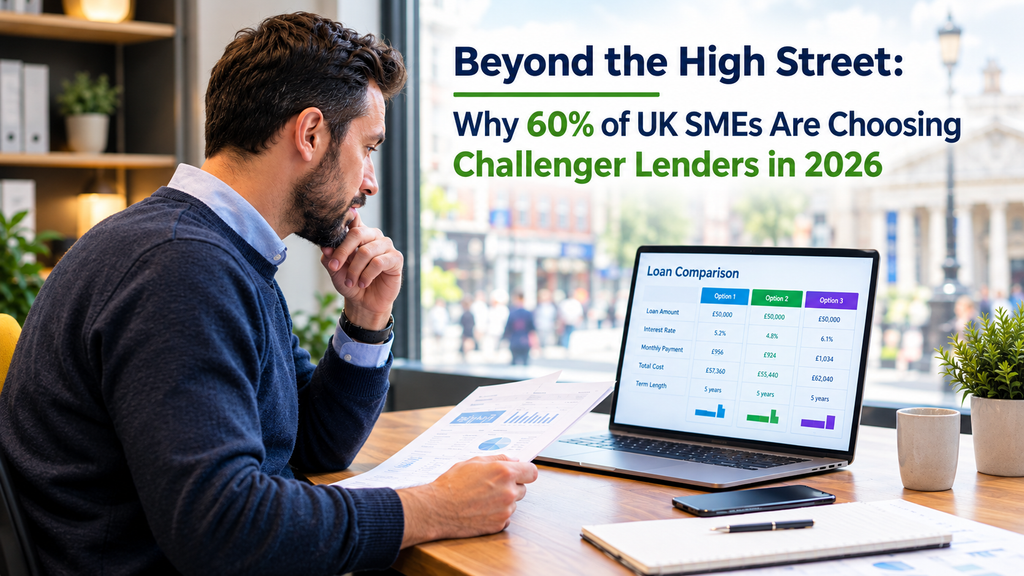
UK business owner comparing challenger bank and high-street lending options
The UK business lending market has quietly changed shape. For decades, the “big five” high-street banks were the default starting point for any business seeking finance. That’s no longer true.
According to the British Business Bank’s most recent Small Business Finance Markets report, challenger and specialist banks now account for 60% of gross SME bank lending, up from just 39% in 2012. Factor in non-bank alternative lenders too, and more than two-thirds of all SME lending now comes from outside the traditional high-street banking system.
This guide explains why that shift has happened, what it means for your business, and how to navigate a lending market that looks nothing like it did a decade ago.
A Market That’s Reshaped Itself Twice Over
It’s worth pausing on the scale of this change. A little over a decade ago, most SME lending was concentrated among a handful of large, familiar names. Today, dozens of new providers have entered the market, from digitally-native challenger banks to specialist fintech lenders, each competing for a share of a growing pool of SME borrowing. This isn’t a passing trend, it’s a structural realignment of how UK businesses access finance.
What Counts as a Challenger Lender?
Challenger and Specialist Banks
These are banks that operate with full banking licences but focus specifically on underserved markets, often SME lending, rather than competing directly with the high street across every product line.
Non-Bank Alternative Lenders
This broader category includes specialist finance providers, fintech lenders, and platforms offering products like unsecured loans, asset finance, and merchant cash advances, often without holding a traditional banking licence at all.
Why the Distinction Matters Less Than You’d Think
For most business owners, the practical difference between a challenger bank and a non-bank alternative lender matters less than the outcome, faster decisions, more flexible criteria, and products built specifically around SME needs rather than adapted from personal or corporate banking models.
The Numbers Behind the Shift
A Decade of Structural Change
In 2012, challenger and specialist banks accounted for just 39% of gross SME bank lending. By 2025, that figure had risen to 60%, a structural shift rather than a temporary blip.
The Bigger Picture
When non-bank lenders are included alongside challenger and specialist banks, more than two-thirds (68%) of all SME lending in 2025 came from outside the traditional high-street banking system.
Lending Volumes Are Recovering Too
Gross SME bank lending reached £68 billion in 2025, a 9% increase on the previous year and the second-highest total in thirteen years, behind only the pandemic-era peak. Much of that growth has come through challenger and specialist lenders, rather than the traditional big banks.
What “60%” Actually Means
It’s worth being precise here. The 60% figure reflects challenger and specialist banks’ share of gross SME bank lending by value, not the literal percentage of individual businesses that have used one. In practice, this means the majority of new lending pounds are now flowing through challenger and alternative channels, even though not every SME has directly borrowed from one yet.
Why High-Street Banks Are Losing Ground
The Cost of Assessing Smaller Loans
Traditional banks increasingly cite the cost and complexity of assessing individual SME applications, relative to the size of each loan, as a reason smaller lending has become commercially less attractive to them.
Falling Approval Rates
Loan approval rates for high-street bank lending have declined significantly over the past decade, from around 74% in 2019 to closer to 50-53% more recently. This has pushed many businesses to explore alternatives simply to get a decision at all.
A Self-Reinforcing Cycle
As approval rates fall, fewer business owners bother applying to traditional banks, expecting rejection. This reduces demand further, which in turn gives banks less incentive to expand SME lending, reinforcing the shift toward alternative providers.
Why SMEs Are Choosing Challenger and Alternative Lenders
Faster Decisions
Many challenger and alternative lenders have built digital-first application processes specifically to reduce approval timelines, often delivering decisions in days rather than the weeks typical of traditional bank underwriting.
More Flexible Criteria
Rather than relying solely on rigid, standardised credit scoring, many alternative lenders assess real-time trading performance, cash flow, and bank statement activity, opening up options for businesses that wouldn’t meet strict high-street criteria.
Products Built Specifically for SMEs
Challenger and specialist lenders often design products around specific SME needs, from merchant cash advances based on card sales to fast-turnaround unsecured business loans, rather than adapting products originally built for personal or corporate banking.
Asset Finance Leading the Way
Asset finance now accounts for a substantial share of gross external business lending, with approval rates significantly higher than many other lending products. Asset finance providers, many of them specialist or challenger lenders, have become a go-to option for businesses investing in equipment and machinery.
What This Means for Your Business
More Choice, But More Complexity
A more diverse lending market gives SMEs genuinely more options and often better rates than a single high-street relationship could offer. But it also means navigating a wider, more fragmented landscape of products and providers.
The Rise of the Broker
With so many lenders now competing for SME business, brokers facilitated an estimated £33 billion of SME lending in a recent year, a substantial year-on-year increase. This reflects a growing recognition that comparing the market properly has become essential, not optional, in a landscape this fragmented.
Why Comparing Matters More Than Ever
With dozens of challenger banks and alternative lenders now active in the UK market, criteria, rates, and approval likelihood vary enormously between providers. Applying directly to a single lender, without comparing your options, risks missing out on better terms elsewhere, or facing an avoidable decline.
Leasing and Alternative Products Are Growing Too
It’s not just loans reshaping the market. Leasing has grown from around 6% of SMEs using it in 2012 to roughly 13% more recently, particularly for equipment and machinery, reflecting a broader shift toward flexible, asset-based finance structures over traditional lump-sum borrowing.
Which Finance Products Are Driving the Shift
Unsecured Business Loans
Unsecured business loans from challenger and alternative lenders often move faster than traditional bank equivalents, with more flexible affordability assessments based on trading performance.
Working Capital Loans
Working capital loans from specialist lenders increasingly focus on cash flow and bank statement data, rather than relying purely on historic credit scoring.
Secured Business Loans
Even in secured lending, challenger banks and specialist providers have expanded significantly, often offering more flexible underwriting than traditional banks for the same loan-to-value.
Merchant Cash Advance
Merchant cash advances are almost entirely the domain of alternative and fintech lenders, reflecting a product built specifically around modern card payment data rather than traditional banking relationships.
How to Navigate the New Lending Landscape
Step 1: Don’t Assume Your Bank Is Your Only Option
If your relationship with a high-street bank hasn’t delivered the terms or speed you need, it’s worth remembering that the majority of new SME lending now flows through challenger and alternative channels instead.
Step 2: Understand What Each Lender Prioritises
Some lenders focus heavily on credit history, others on real-time cash flow, and others on the specific asset being financed. Understanding this before you apply improves your chances of a fast, successful outcome.
Step 3: Compare Multiple Providers, Not Just One
Given how fragmented the market has become, comparing terms across several lenders, rather than applying to just one, is now the single most effective way to secure competitive terms.
Step 4: Use a Broker to Simplify the Process
A broker who understands the full landscape, high-street, challenger, and alternative, can match your business to the right lender first time, rather than leaving you to research dozens of providers individually.
Why Choose 247 Business Finance to Navigate This Market
We compare across high-street banks, challenger lenders, and alternative providers, helping you access the right funding without getting lost in an increasingly complex market.
Our Key Advantages
90% Approval Rates
We work with a wide panel of lenders across the entire market, helping match your business to the right option. See our 90% approval rate plans.
Faster Funding Options
We understand that speed matters in today’s market. Explore our faster funding options.
Flexible Repayments
We help match you to a repayment structure suited to your business, wherever it comes from across the market. Learn more about our flexible repayment options.
Less Paperwork
We keep the comparison and application process efficient. Find out more about our low paperwork process.
Low Interest Rates
By comparing across the whole market, including challenger and specialist lenders, we help you access competitive rates. Check our low interest rate options.
Other Finance Options Worth Exploring
- Unsecured Business Loan — fast, flexible funding without collateral
- Secured Business Loan — larger amounts backed by an asset
- Working Capital Loan — for day-to-day cash flow needs
- Merchant Cash Advance — funding based on card sales
- Asset Finance — fund equipment or machinery
- Business Card Payment Solutions — improve how you take payments
Frequently Asked Questions
What’s the Difference Between a Challenger Bank and a Traditional Bank?
A challenger bank holds a full banking licence like a traditional bank but typically focuses on specific underserved markets, such as SME lending, with more flexible, often digitally-driven underwriting processes.
Are Challenger Lenders Safe to Borrow From?
Yes. Regulated challenger and specialist banks operate under the same regulatory oversight as traditional banks. It’s always worth checking a lender’s regulatory status, but being a challenger rather than a household name doesn’t indicate lower legitimacy.
Why Are High-Street Banks Approving Fewer SME Loans?
Rising costs associated with assessing smaller loan applications, combined with more standardised credit criteria, have contributed to declining approval rates at traditional banks compared to previous years.
Is It Harder to Get a Loan From a Challenger Bank Than a Traditional Bank?
Not necessarily. Many challenger and alternative lenders assess applications more flexibly, focusing on real-time trading performance rather than relying purely on historic credit data, which can make approval more accessible for some businesses.
Should I Still Approach My High-Street Bank First?
Not necessarily. Given that the majority of new SME lending now comes from outside traditional high-street channels, comparing your options broadly, rather than defaulting to your existing bank, often produces better results.
How Can a Broker Help Me Navigate This Market?
A broker can compare your business against a wide panel of high-street, challenger, and alternative lenders simultaneously, helping you find the most suitable and competitive option without researching and applying to each individually.
Final Thoughts
The days of the high-street bank as the automatic first choice for business finance are firmly behind us. With challenger and specialist banks now responsible for 60% of gross SME bank lending, and alternative lenders pushing that figure even higher when combined, UK businesses have more genuine choice than ever before.
That choice brings real opportunity, faster decisions, more flexible criteria, and products built specifically for SME needs, but it also demands a more informed approach to comparing the market. Understanding where the funding landscape has moved, and adapting your search accordingly, puts your business in a far stronger position than relying on a single traditional relationship.
Get in touch with 247 Business Finance today.
📞 Call us: (0800) 061 4919 📧 Email: info@247businessfinance.com 🌐 Get your free quote now
We compare the market so you don’t have to, helping UK SMEs access the right funding, wherever it comes from.