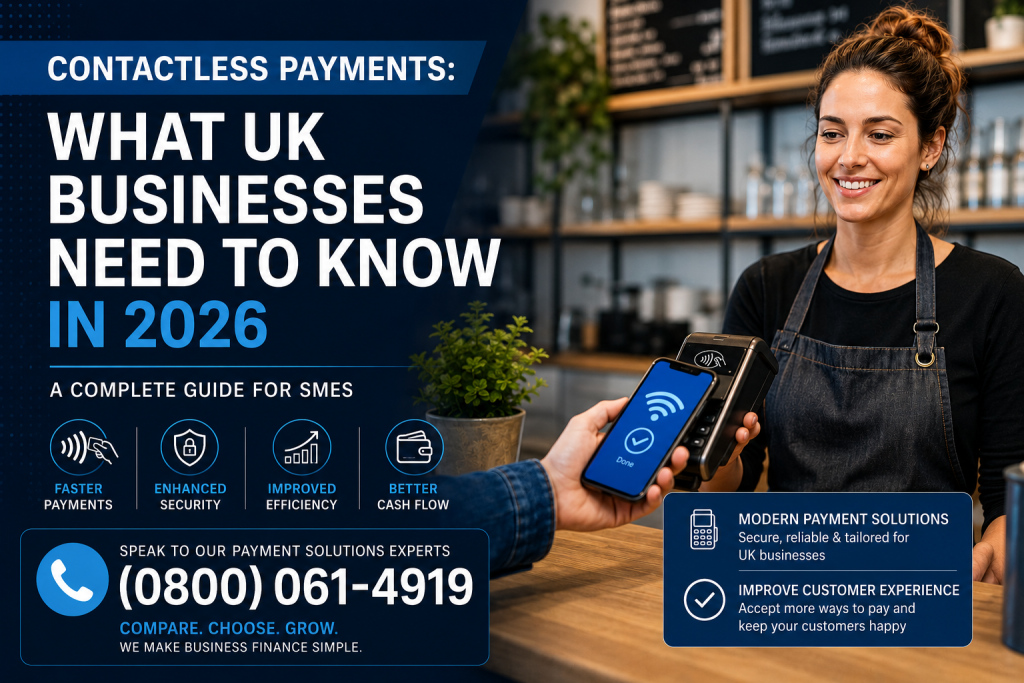
Contactless Payments: What UK Businesses Need to Know in 2026
The Complete Guide to Contactless Card Payments, Business Card Machines, POS Systems, and Cashless Transactions for UK SMEs
As customer expectations evolve and digital technology advances, contactless payments have become the preferred payment method for millions of consumers across the UK. Whether customers are tapping a debit card, using Apple Pay, Google Pay, or making purchases through a digital wallet, businesses are expected to offer fast, secure, and convenient payment options.
For UK SMEs, adopting modern business payment solutions is no longer just about keeping up with competitors—it’s about improving customer experience, increasing sales, enhancing operational efficiency, and future-proofing the business.
In this comprehensive guide, we’ll explain everything UK businesses need to know about contactless payments, how they work, their benefits, security considerations, and how to choose the right card payment solution.
Why Contactless Payments Are Becoming the UK Standard
The UK is one of the world’s leading cashless economies.
Consumers increasingly expect businesses to accept:
- Contactless debit cards
- Contactless credit cards
- Apple Pay
- Google Pay
- Samsung Wallet
- Wearable payment devices
- Mobile wallets
According to UK Finance, contactless payments now account for a significant proportion of everyday transactions across the UK, reflecting changing consumer habits and widespread merchant adoption.
Learn more from UK Finance:
https://www.ukfinance.org.uk/
For SMEs, failing to offer contactless payment options can result in lost sales and a poorer customer experience.
What Are Contactless Payments?
Contactless payments allow customers to make purchases by simply tapping a compatible payment card, smartphone, smartwatch, or other enabled device against a payment terminal.
The technology uses Near Field Communication (NFC) to securely transfer encrypted payment information between the customer’s device and the merchant’s card machine.
Transactions typically complete within seconds, making contactless payments faster than traditional Chip & PIN transactions.
How Contactless Payments Work
Although the process is simple for customers, several technologies work together behind the scenes.
Step 1: Customer Taps Their Device
Customers can pay using:
- Contactless debit card
- Contactless credit card
- Apple Pay
- Google Pay
- Smartwatch
- Mobile wallet
Step 2: Secure Authentication
The payment terminal communicates securely using NFC technology.
Sensitive card information is protected through advanced encryption and tokenisation.
Step 3: Payment Authorisation
The payment request is securely transmitted through:
- Merchant services provider
- Card network
- Customer’s bank
Approval normally takes only a few seconds.
Step 4: Transaction Complete
Funds are authorised, the payment is confirmed, and the customer receives a receipt if required.
The entire process usually takes less than five seconds.
Why UK SMEs Should Accept Contactless Payments
Modern customers value convenience.
Businesses that offer fast and flexible payment options often experience:
- Faster checkout times
- Improved customer satisfaction
- Higher average transaction values
- Reduced cash handling
- Better operational efficiency
Whether you run a retail shop, café, restaurant, salon, medical practice, or professional service, accepting contactless payments helps create a smoother customer experience.
If you’re looking to upgrade your payment technology, explore our Business Payment Solutions and Merchant Services tailored for UK SMEs.
Benefits of Contactless Payments for UK Businesses
Faster Transactions
Speed is one of the biggest advantages.
Contactless payments significantly reduce queues during busy trading periods.
This is especially valuable for:
- Retail stores
- Coffee shops
- Restaurants
- Convenience stores
- Pharmacies
- Entertainment venues
Faster service often leads to greater customer satisfaction.
Improved Customer Experience
Customers increasingly expect businesses to accept multiple payment methods.
Offering contactless payments demonstrates that your business is modern, convenient, and customer-focused.
A seamless checkout process encourages repeat business and positive reviews.
Increased Sales
Research consistently suggests that customers tend to spend more when paying electronically rather than using cash.
Businesses may also benefit from:
- Reduced abandoned purchases
- Higher impulse buying
- Improved checkout efficiency
- Greater payment flexibility
Better Cash Flow Management
Digital payments simplify financial management by providing accurate transaction records.
Benefits include:
- Easier bookkeeping
- Faster reconciliation
- Improved financial reporting
- Reduced cash handling risks
Enhanced Security
Handling less cash can reduce:
- Theft
- Human error
- Cash shortages
- Banking trips
- Insurance risks
Modern card payment systems also include robust fraud prevention measures.
Which Businesses Benefit Most?
Almost every industry can benefit from contactless payment technology.
Retail
Retail businesses use contactless payments for:
- Faster checkouts
- Inventory integration
- Loyalty programmes
- Digital receipts
Hospitality
Restaurants and cafés benefit from:
- Table-side payments
- Faster service
- Split bills
- Tip functionality
Professional Services
Solicitors, accountants, and consultants increasingly accept card payments for improved convenience and cash flow.
Healthcare
Clinics, dentists, physiotherapists, and private healthcare providers benefit from quick, secure patient payments.
Tradespeople
Electricians, plumbers, builders, and mobile contractors can take payments on-site using portable card machines.
Beauty & Personal Care
Salons, spas, and barbers enjoy quicker checkouts and reduced cash handling while improving the client experience.
Contactless Payments vs Cash
| Contactless Payments | Cash |
|---|---|
| Fast checkout | Slower handling |
| Digital records | Manual reconciliation |
| Reduced theft risk | Higher cash security concerns |
| Supports digital wallets | Cash only |
| Convenient for customers | Increasingly less preferred |
While cash remains important for some businesses, many UK consumers now prefer cashless transactions for speed and convenience.
Contactless Payments vs Chip & PIN
| Contactless | Chip & PIN |
|---|---|
| Tap to pay | Insert card |
| Faster transactions | Slightly slower |
| Ideal for busy environments | Suitable for all payment values |
| Excellent customer experience | Traditional payment method |
Both payment methods remain valuable, but contactless technology is now the preferred option for many everyday purchases.
Business Card Machines That Support Contactless Payments
Modern card machines typically accept:
- Visa
- Mastercard
- American Express
- Apple Pay
- Google Pay
- Samsung Wallet
- Contactless debit cards
- Contactless credit cards
Many devices also integrate with intelligent point-of-sale (POS) systems, making payment processing even more efficient.
If you’re comparing payment technology, our Merchant Services and Card Machine Solutions can help you find the right option for your business.
Intelligent POS Systems
A modern POS system does much more than process payments.
It can also help businesses manage:
- Stock control
- Customer data
- Staff management
- Sales reporting
- Inventory
- VAT reporting
- Loyalty programmes
- Digital receipts
Integrated payment solutions help improve operational efficiency while providing valuable business insights.
Mobile Card Readers
Portable card readers are particularly useful for:
- Market traders
- Food trucks
- Tradespeople
- Delivery businesses
- Pop-up shops
- Mobile professionals
These devices allow businesses to accept secure payments wherever they operate, increasing flexibility and convenience.
Digital Wallets: The Future of Business Payments
Digital wallets have transformed the way consumers pay for goods and services. Instead of carrying physical cards or cash, customers can make secure purchases using their smartphones, smartwatches, or other connected devices.
The most widely used digital wallets in the UK include:
- Apple Pay
- Google Pay
- Samsung Wallet
- Garmin Pay
- Fitbit Pay
These payment methods use advanced encryption and tokenisation, making transactions both fast and secure.
For UK SMEs, accepting digital wallet payments helps improve customer convenience and supports a modern, technology-driven business image.
Why Customers Prefer Digital Wallets
Consumers increasingly favour digital wallets because they offer:
- Faster checkout experiences
- Enhanced payment security
- Reduced need to carry cash
- Contact-free transactions
- Seamless online and in-store payments
Businesses that support multiple payment methods are often better positioned to meet changing customer expectations and increase conversion rates.
Contactless Card Machines for Modern Businesses
Today’s card machines are far more advanced than traditional payment terminals.
Modern devices support:
- Contactless cards
- Chip & PIN
- Apple Pay
- Google Pay
- QR code payments
- Digital receipts
- Mobile connectivity
- Wi-Fi connectivity
- Bluetooth integration
Many intelligent card machines also integrate directly with inventory management and accounting software, reducing administrative work and improving operational efficiency.
If you’re considering upgrading your payment technology, compare our Business Card Machine Solutions and Merchant Services for UK SMEs.
Intelligent POS Systems
A modern Point of Sale (POS) system is much more than a payment terminal.
Today’s intelligent POS systems help businesses manage:
Sales Reporting
Track:
- Daily sales
- Weekly performance
- Monthly revenue
- Best-selling products
Real-time reporting enables business owners to make informed decisions quickly.
Inventory Management
Integrated POS systems automatically update stock levels after every sale.
Benefits include:
- Reduced stock shortages
- Better purchasing decisions
- Improved inventory accuracy
Customer Relationship Management (CRM)
Many modern POS systems include CRM features that help businesses:
- Track customer purchases
- Build loyalty programmes
- Send promotional offers
- Improve customer retention
Employee Management
Advanced systems can monitor:
- Staff logins
- Sales performance
- Shift management
- User permissions
This improves accountability and operational efficiency.
Mobile Card Machines
Portable payment terminals are becoming increasingly popular across the UK.
Ideal industries include:
- Electricians
- Plumbers
- Builders
- Landscapers
- Taxi services
- Market traders
- Food trucks
- Delivery companies
Accepting payments at the customer’s location reduces payment delays and improves cash flow.
Benefits of Integrated Payment Solutions
Businesses that combine their payment systems with accounting and inventory software often benefit from:
- Reduced manual data entry
- Faster reconciliation
- Accurate VAT reporting
- Better financial visibility
- Improved operational efficiency
Integration also reduces administrative errors and saves valuable staff time.
Are Contactless Payments Secure?
One of the most common questions business owners ask is whether contactless payments are safe.
The answer is yes.
Modern payment technology uses multiple layers of security.
These include:
- End-to-end encryption
- Tokenisation
- Fraud monitoring
- Secure payment gateways
- PCI DSS compliance
These measures help protect both businesses and customers from payment fraud.
Tokenisation Explained
Instead of transmitting actual card details during a transaction, digital wallets replace sensitive information with a unique encrypted token.
Even if payment data were intercepted, it would be unusable to criminals.
This significantly reduces fraud risks compared to older payment technologies.
PCI DSS Compliance
Businesses accepting card payments should understand the importance of PCI DSS (Payment Card Industry Data Security Standard).
PCI DSS helps businesses protect customer payment information through security best practices.
Guidance is available from the PCI Security Standards Council:
https://www.pcisecuritystandards.org/
Understanding Merchant Service Fees
Merchant service costs vary depending on:
- Card type
- Transaction volume
- Industry
- Payment method
- Card machine provider
Typical charges may include:
- Transaction fees
- Monthly service fees
- Terminal rental
- Gateway fees
- Authorisation charges
Comparing providers helps businesses secure competitive pricing without compromising service quality.
Our Merchant Services Comparison helps UK businesses identify cost-effective payment solutions tailored to their needs.
How to Choose the Right Card Payment Solution
Every business has different payment requirements.
Before choosing a payment provider, consider:
Business Size
A sole trader has different needs from a multi-location retailer.
Payment Volume
Businesses processing thousands of transactions each month may benefit from lower transaction rates.
Mobility
Do you require:
- Countertop terminals?
- Portable card machines?
- Mobile card readers?
- Integrated POS systems?
Customer Experience
Look for solutions offering:
- Fast transaction speeds
- Contactless acceptance
- Digital receipts
- Easy refunds
- Multi-payment support
Integration
The best payment systems integrate with:
- Accounting software
- Stock management
- CRM platforms
- Ecommerce systems
This reduces manual work and improves reporting accuracy.
Common Mistakes Businesses Should Avoid
Many SMEs select payment solutions based solely on headline pricing.
Instead, consider the total value offered.
Common mistakes include:
Choosing the Cheapest Provider
Lower monthly costs may result in:
- Higher transaction fees
- Poor customer support
- Limited functionality
Ignoring Future Growth
Choose a scalable payment solution that grows with your business.
Overlooking Integration
Disconnected systems often increase administration and create unnecessary duplication.
Not Comparing Providers
Businesses should compare:
- Pricing
- Hardware
- Support
- Features
- Contract flexibility
Working with an independent broker can simplify the comparison process.
The Future of Contactless Payments
Payment technology continues to evolve rapidly.
Emerging trends include:
- Biometric authentication
- AI-powered fraud detection
- QR code payments
- SoftPOS (Tap-to-Phone)
- Open Banking payments
- Embedded finance
- Digital identity verification
Businesses that embrace these innovations will be better positioned to meet customer expectations and remain competitive.
Frequently Asked Questions (FAQs)
1. What are contactless payments?
Contactless payments allow customers to pay by simply tapping a contactless-enabled debit card, credit card, smartphone, smartwatch, or other NFC-enabled device on a compatible payment terminal. This provides a fast, secure, and convenient payment experience for both customers and businesses.
2. Are contactless payments safe for businesses?
Yes. Modern contactless payments use advanced security technologies such as encryption, tokenisation, and fraud monitoring. Reputable payment providers also comply with the Payment Card Industry Data Security Standard (PCI DSS), helping protect sensitive customer information.
Learn more about PCI DSS on the PCI Security Standards Council.
3. What types of businesses should accept contactless payments?
Almost every business can benefit from contactless payments, including:
- Retail stores
- Restaurants and cafés
- Salons and barbers
- Tradespeople
- Medical and dental clinics
- Professional services
- Hotels
- Gyms
- Convenience stores
- Mobile businesses
Accepting multiple payment methods improves customer convenience and can increase sales.
4. Do I need a special card machine for contactless payments?
Yes. You’ll need a modern card payment terminal that supports NFC (Near Field Communication) technology. Most new business card machines also accept Apple Pay, Google Pay, Samsung Wallet, and contactless bank cards.
Compare our Business Card Machine Solutions to find the right device for your business.
5. Can small businesses accept Apple Pay and Google Pay?
Absolutely. Most modern merchant terminals support popular digital wallets, allowing customers to pay using smartphones and smartwatches. This provides greater flexibility and a faster checkout experience.
6. How much do contactless payment solutions cost?
Costs vary depending on the provider and solution chosen. Typical charges may include:
- Transaction fees
- Monthly service fees
- Card terminal rental
- Payment gateway fees (for online businesses)
Working with an independent broker can help you compare providers and secure competitive pricing.
7. What is the difference between a card machine and a POS system?
A card machine primarily processes payments.
A Point of Sale (POS) system combines payment processing with features such as:
- Inventory management
- Sales reporting
- Customer relationship management (CRM)
- Employee management
- Analytics
- Digital receipts
Many UK SMEs choose integrated POS systems to improve efficiency and gain valuable business insights.
8. Can contactless payments improve cash flow?
Yes. Electronic payments are typically processed quickly, making it easier to manage business finances, reconcile transactions, and monitor cash flow. Faster payment processing can also reduce the need to handle cash.
9. How can I choose the best merchant services provider?
When comparing providers, consider:
- Transaction fees
- Contract flexibility
- Customer support
- Hardware options
- Integration with existing systems
- Scalability
- Security features
Our Merchant Services specialists can help you compare trusted UK providers.
10. Are contactless payment limits still important?
Many contactless transactions no longer rely solely on a fixed spending limit because digital wallets often use biometric authentication such as fingerprint or facial recognition. Banks and payment providers may still apply their own security measures depending on the transaction and payment method.
11. Can I accept contactless payments without a physical shop?
Yes. Portable card machines and mobile payment terminals enable businesses such as tradespeople, market traders, food trucks, delivery services, and mobile professionals to accept payments wherever they operate.
12. Why should I compare merchant service providers?
Comparing providers allows businesses to find the best combination of:
- Competitive pricing
- Reliable hardware
- Flexible contracts
- Better customer support
- Advanced payment features
This can reduce costs while improving the customer payment experience.
Final Thoughts
The way customers pay has changed dramatically over the last decade. Contactless payments are now an essential part of doing business in the UK, offering speed, convenience, and security for both businesses and consumers.
Whether you operate a retail store, restaurant, professional practice, or mobile business, investing in modern payment technology can help you:
- Improve customer satisfaction
- Increase sales opportunities
- Speed up checkout times
- Reduce cash handling
- Gain valuable business insights
- Support long-term business growth
By choosing the right merchant services provider and payment technology, your business will be well-positioned to meet evolving customer expectations and remain competitive in an increasingly cashless economy.
Why Choose 247 Business Finance?
At 247 Business Finance, we help UK SMEs compare merchant services, card machines, intelligent POS systems, and business payment solutions from trusted providers.
Businesses choose us because we offer:
- 90% Approval Rates*
- Faster Setup
- Flexible Business Solutions
- Less Paperwork
- Competitive Merchant Services
- Expert UK-Based Support
Learn more about our experienced business finance specialists and discover why UK SMEs choose 247 Business Finance.
Ready to Upgrade Your Business Payments?
Whether you’re looking for a portable card machine, an intelligent POS system, or a complete payment solution, our team can help you compare options that suit your business.
Speak to Our Experts Today
📞 0800-061-4919
Explore our Business Payment Solutions & Merchant Services
Visit 247 Business Finance to discover how we help UK businesses improve payment efficiency, streamline operations, and support long-term growth.