Merchant Cash Advance vs Business Loan

Merchant Cash Advance vs Business Loan: What’s Best for Retail & Hospitality?
Retail and hospitality businesses run on a different rhythm than most other industries. Sales swing with the seasons. Footfall changes with the weather. And cash often comes in through card payments, day after day, in small but steady amounts.
This rhythm matters when it comes to choosing the right finance option. A merchant cash advance and a traditional business loan both offer funding, but they work in very different ways.
In this guide, we break down exactly how each option works, who they suit best, and how to decide which one fits your retail or hospitality business.
A Sector With Unique Financial Rhythms
Few industries experience cash flow quite like retail and hospitality. A restaurant might do half its weekly trade over a single weekend. A seaside shop might earn most of its annual income across a few summer months. A city-centre cafe might see footfall drop sharply during school holidays.
This constant variation makes choosing the right type of finance more important than in many other sectors. Get it right, and funding supports your business through its natural ups and downs. Get it wrong, and repayments can add pressure exactly when you can least afford it.
Why Retail and Hospitality Businesses Need Flexible Finance
The Nature of the Industry
Retail and hospitality businesses face unique financial pressures. Rent is high. Staff costs are significant. Stock needs constant reinvestment. And trading can swing dramatically between busy weekends and quiet weekdays, or peak seasons and off-peak months.
Why Standard Finance Doesn’t Always Fit
Traditional finance products are often built around fixed monthly repayments, regardless of how much a business actually takes in that month. For a retail shop or restaurant with fluctuating income, that rigidity can create real pressure during quieter periods.
This is exactly why alternative finance products, like merchant cash advances, have grown in popularity across the UK retail and hospitality sector.
What Is a Merchant Cash Advance?
The Basics
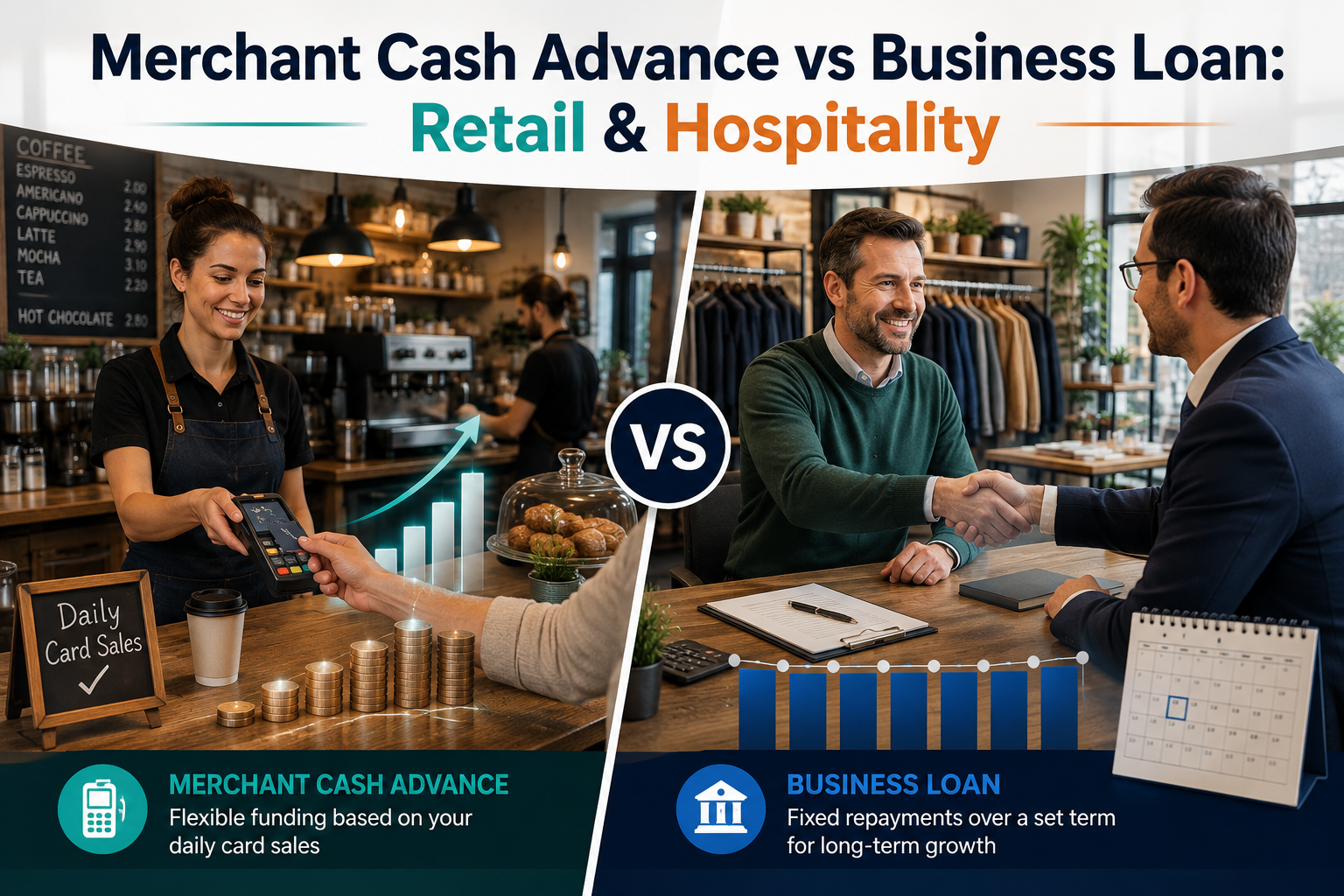
A merchant cash advance (MCA) is a form of funding based on your future card sales. Instead of borrowing a fixed amount and repaying it in equal monthly instalments, you receive a lump sum upfront and repay it through a small, agreed percentage of your daily card transactions.
How Repayments Work
Repayments flex with your sales. On a busy trading day, you repay a little more. On a quiet day, you repay less. This makes an MCA naturally suited to businesses with variable income, like shops, cafes, restaurants, salons, and bars.
Who Typically Uses a Merchant Cash Advance?
- Independent retailers
- Restaurants and cafes
- Bars and pubs
- Hair and beauty salons
- Takeaways and quick-service outlets
Any business that takes a high volume of card payments is usually a strong candidate.
What Is a Traditional Business Loan?
The Basics
A business loan provides a lump sum of funding, which you repay in fixed instalments over an agreed term, typically monthly, regardless of how your trading performs that month.
Secured vs Unsecured Business Loans
Business loans generally come in two forms:
- Secured business loans — backed by a business or personal asset, often allowing for larger amounts and lower interest rates.
- Unsecured business loans — no collateral required, though terms depend heavily on your business’s financial track record.
Who Typically Uses a Business Loan?
- Businesses seeking a specific, planned investment
- Businesses with predictable, stable monthly income
- Businesses expanding into a new site or location
- Businesses purchasing large equipment or renovating premises
Merchant Cash Advance vs Business Loan: Key Differences
Repayment Structure
A merchant cash advance repays through a percentage of daily card sales. A business loan repays through fixed monthly instalments, set in advance and unaffected by trading performance.
Speed of Funding
Merchant cash advances are typically known for fast turnaround, often within a few days, since approval is based largely on your card transaction history rather than lengthy financial assessments.
Business loans can also move quickly through a broker, though secured loans may take slightly longer due to asset valuation and legal checks.
Impact on Cash Flow
Because MCA repayments scale with sales, they tend to be gentler on cash flow during quiet periods. Business loan repayments stay fixed, which can create pressure if a quiet month coincides with a scheduled repayment date.
Eligibility Requirements
MCAs are often more accessible to businesses with a strong volume of card transactions, even if overall credit history isn’t perfect. Business loans, particularly larger unsecured ones, tend to rely more heavily on credit score, trading history, and financial statements.
Total Cost of Funding
Merchant cash advances often carry a factor rate rather than a traditional interest rate, which can make the total cost higher over time compared to a well-priced business loan. It’s important to compare the total repayable amount, not just the headline rate, when weighing up your options.
A Simple Way to Compare Costs
Ask any lender or broker for the total amount repayable, not just the advance amount or the interest rate. This gives you a clear, apples-to-apples comparison between an MCA and a business loan.
Term Length and Renewal
Merchant cash advances are typically short-term, often repaid within 6 to 12 months depending on trading volume. Business loans can range from a few months to several years, giving you more flexibility over how long you spread the cost.
It’s also worth asking whether an MCA can be renewed or topped up once repaid, since some businesses use them repeatedly as an ongoing cash flow tool, while others prefer to move to a longer-term loan once their finances stabilise.
When a Merchant Cash Advance Makes Sense for Retail & Hospitality
You Have Strong, Consistent Card Sales
If most of your revenue comes through card transactions, whether that’s a busy restaurant, a retail shop, or a salon, an MCA can align naturally with how your money flows in.
You Need Funding Fast
If you need cash quickly, to cover a stock order, an unexpected repair, or a short-term gap, an MCA’s fast approval process can be a major advantage.
Your Trading Is Seasonal or Variable
Businesses with busy and quiet periods often prefer MCAs because repayments naturally scale down when trading slows, reducing financial strain during off-peak months.
You Want to Avoid Fixed Monthly Pressure
If the idea of a fixed repayment date, regardless of how business is going that month, feels risky, an MCA’s flexible repayment style may feel more comfortable.
When a Traditional Business Loan Makes Sense for Retail & Hospitality
You’re Planning a Specific, Larger Investment
If you’re opening a new location, refurbishing your premises, or investing in new kitchen or retail equipment, a structured loan with a clear repayment plan may suit you better than a rolling cash advance.
You Have Predictable, Stable Income
If your trading income is steady and predictable month to month, fixed repayments won’t create the same pressure they might for a highly seasonal business.
You Want a Lower Overall Cost of Borrowing
If you qualify for competitive rates, particularly through a secured loan, the overall cost of borrowing may work out lower over the loan term compared to an MCA.
You Prefer Clear, Long-Term Planning
A business loan offers a defined start date, end date, and repayment schedule, which some business owners find easier to plan and budget around.
A Side-by-Side Comparison
| Feature | Merchant Cash Advance | Business Loan |
|---|---|---|
| Repayment style | Percentage of daily card sales | Fixed monthly instalments |
| Speed of funding | Very fast | Fast to moderate |
| Best suited for | Variable, card-heavy income | Stable, predictable income |
| Flexibility during quiet periods | High | Low |
| Typical use case | Short-term cash flow, stock, repairs | Expansion, equipment, renovation |
| Collateral required | Usually none | Depends (secured or unsecured) |
How to Decide Which Option Is Right for Your Business
Step 1: Look at Your Cash Flow Pattern
Start by reviewing how consistent your monthly income really is. If it swings significantly, an MCA’s flexible repayment structure may suit you better.
Step 2: Define What the Funding Is For
Short-term needs, like stock replenishment or an unexpected repair, often suit an MCA. Larger, planned investments often suit a structured business loan instead.
Step 3: Compare the Total Cost
Always ask for the total repayable amount on both options, not just headline rates or factor rates. This gives you a true comparison.
Step 4: Speak to a Business Finance Broker
A broker can compare multiple lenders and products on your behalf, helping you avoid overpaying and matching you to the option that best fits your specific trading pattern.
Step 5: Read the Fine Print Before You Commit
Whichever option you lean towards, check for early repayment charges, renewal terms, and how repayments are calculated during particularly quiet trading weeks. A good broker will walk you through this in plain English before you sign anything, so there are no surprises once funding is in place.
Why Choose 247 Business Finance for Retail & Hospitality Funding
We work with retail and hospitality businesses across the UK, helping them access the right funding quickly and without unnecessary paperwork.
Our Key Advantages
90% Approval Rates
We compare a wide panel of lenders to match your business with the right funding option. See our 90% approval rate plans.
Faster Funding Options
We understand that retail and hospitality businesses often need funds quickly. Explore our faster funding options.
Flexible Repayments
We help match you to a repayment structure that fits your trading pattern, not a generic monthly figure. Learn more about our flexible repayment options.
Less Paperwork
We keep the application process simple and quick, so you can focus on running your business. Find out more about our low paperwork process.
Low Interest Rates
By comparing the market, we help you avoid overpaying for your funding. Check our low interest rate options.
Other Finance Options Worth Considering
Depending on your specific situation, one of these other options might also be worth exploring:
- Working Capital Loan — for covering day-to-day cash flow gaps
- Asset Finance — for funding kitchen equipment, fixtures, or fittings
- Start Up Loan — for newer retail or hospitality businesses
- Recovery Loan Scheme — government-backed support for eligible businesses
- Business Card Payment Solutions — improve how you take payments in-store
Frequently Asked Questions
Is a Merchant Cash Advance More Expensive Than a Business Loan?
It can be, depending on the factor rate and how quickly you repay. It’s important to compare total repayable amounts rather than headline rates alone.
Can New Retail or Hospitality Businesses Get a Merchant Cash Advance?
Most lenders prefer to see a consistent trading history and card transaction record, so newer businesses may find a start up loan or unsecured loan more accessible initially.
Do I Need Good Credit for a Merchant Cash Advance?
Credit history matters less for MCAs than it does for many business loans, since approval is largely based on card sales volume and consistency.
Can I Use Both a Merchant Cash Advance and a Business Loan Together?
Yes, some businesses combine short-term MCA funding for immediate cash flow needs with a longer-term loan for planned investment. A broker can help structure this appropriately.
How Quickly Can I Access Funds Through 247 Business Finance?
Funding timelines vary by lender and product, though many merchant cash advances and unsecured loans can be arranged within a matter of days.
Final Thoughts
Both merchant cash advances and traditional business loans have a place in retail and hospitality finance. The right choice depends on how your income flows, what the funding is for, and how much flexibility you need during quieter trading periods.
An MCA suits businesses with strong, consistent card sales that want fast, flexible funding aligned to daily trading. A business loan suits businesses planning a specific investment, with stable income and a preference for fixed, predictable repayments.
Whichever direction fits your business, comparing your options properly makes all the difference.
Get in touch with 247 Business Finance today.
📞 Call us: (0800) 061 4919 📧 Email: info@247businessfinance.com 🌐 Get your free quote now
We compare the market so you don’t have to, helping UK retail and hospitality businesses find the right finance option, faster.
This publication is intended solely for general commercial financial guidance and does not constitute formal regulated credit or tax advice. Borrowing facilities are subject to status, company turnover assessment, and lender underwriting approval.